Showing posts with label Stone age art. Show all posts

Sunday, 17 December 2023

Eolith Discovery in Southern England Reveals Australopithecus Sculpture

Introduction: In the heart of Southern England, a groundbreaking eolith discovery is challenging the mainstream understanding of prehistoric art and human history. This extraordinary find features a striking frontal sculpture that uncannily resembles an Australopithecus, offering a new perspective on early human creativity. 


A Glimpse into the Past:
Unearthed from a site rich in historical artefacts, this eolith stands out for its remarkable symmetry and detailed craftsmanship. The sculpture presents a face with deep-set eyes, possibly depicting a winking expression or even a hooded figure. This interpretation is further enhanced by the head shape, which aligns closely with our knowledge of Australopithecus anatomy.  

Artistic Mastery in Stone: The craftsmanship of this eolith is nothing short of stunning. Its symmetrical design and the intricate detailing of the facial features suggest a level of artistic skill not commonly attributed to early human artists. The deep holes for eyes, in particular, add a level of depth and realism that is rarely seen in prehistoric artefacts. 


A Tapestry of Faces and Symbols:
Beyond the prominent Australopithecus representation, this eolith is a treasure trove of other faces and symbols commonly found in flint tools and art objects from the region. Each marking and figure on the stone tells a story, offering insights into the cultural and artistic expressions of our ancestors and as my study suggests a kind of world wide prehistoric proto-language, or just a silent hunting aid. 

Implications for Prehistoric Art Studies: This discovery is not just a testament to the artistic abilities of early humans but also a potential paradigm shift in how we understand prehistoric art. The sophistication and clarity of the sculpture challenge the notion that early human art was rudimentary or purely functional.  

 The above photo taken from another angle of the prehistoric sculpture is reminiscent of a bear face description, although it is in fact a complex mash-up of ancient symbolism. Those more familiar with my research may notice the ambiguous optical illusion of a left and downward facing hominid head profile and a right facing bear front half. 


Conclusion: The discovery of this eolith in Southern England is a remarkable addition to the world of archaeology and prehistoric art studies. It compels us to reconsider our perceptions of early human artistry and opens up new avenues for research and exploration in human history. 

Call to Action: Stay tuned for more updates on this extraordinary find and join us in exploring the depths of human history and creativity. Share this post to spread awareness of this incredible discovery!

Another face in the sculpture displays a rather simple chimp impression.

Sunday, 25 June 2023

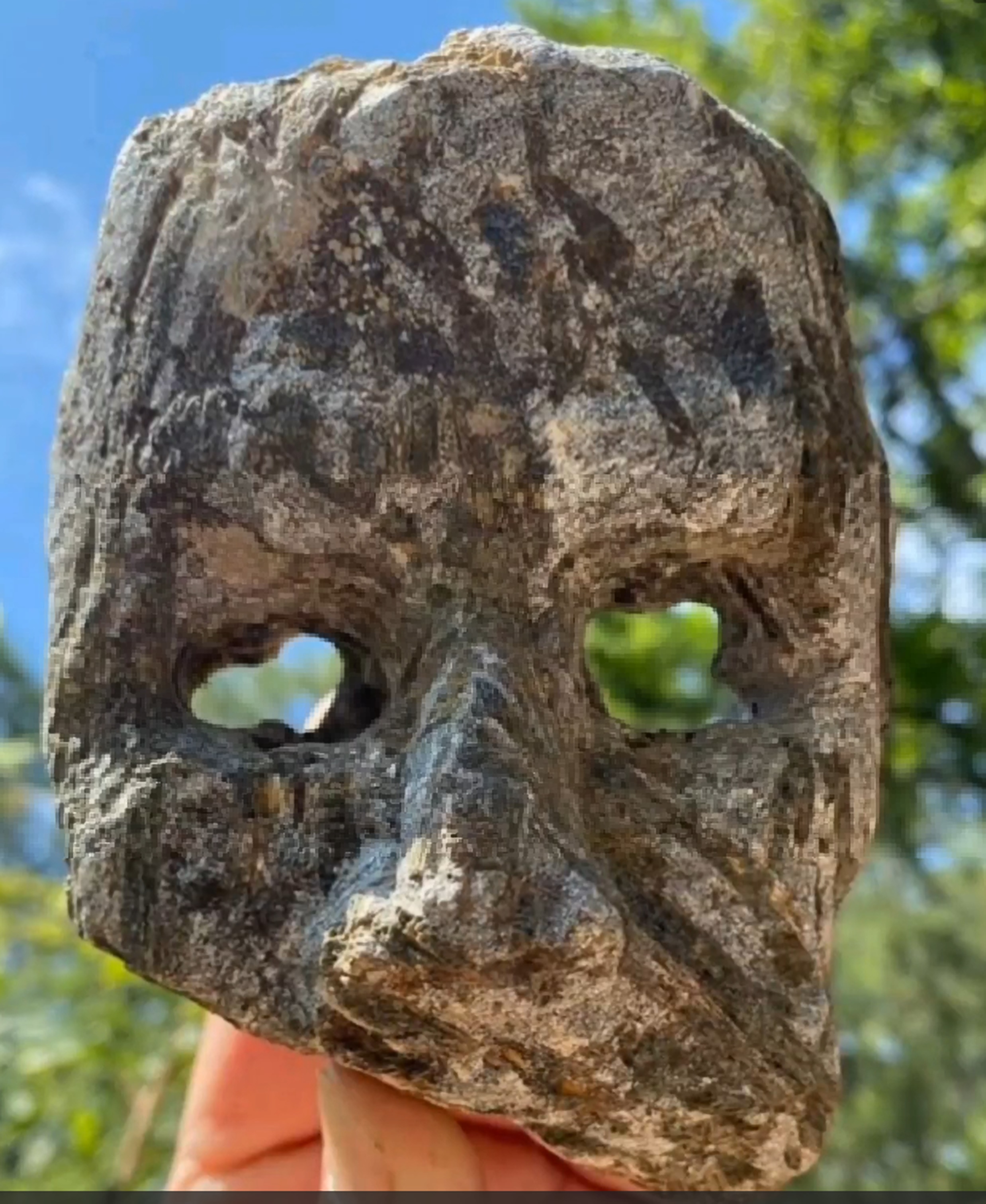
Ancient face mask - Figure Stone

This is quite a stunning piece of portable rock art found in North Carolina, United States by Brandon McDonald. It appears as a face mask, but I would suggest its a lot more than that as it clearly displays the convention and common content by my definition of a figure stone.

Looking carefully at the find many figurative interpretations can be made, and many are credible due to the fact that I've predefined these and described and demonstrated them numerously on this blog and put them in my 'Figure Stone Key' of this global ancient art phenomena. 

I think that what is most important here is the modern human like face description,  it displays no apparent archaic features, the nose is very well defined and the brow ridge looks normal for a human and does not look as thick set as expected if this was a depiction of Neanderthal or Homo-Neanderthal. This fits with my theory that Humans are responsible for the world wide figurative art topology, even though in many cases art finds appear to be in the multi-million year age range (well before dubious theory concerning human chronology).

The find also displays proboscidean descriptions in the expected front half convention, both left and right facing, and possibly on both sides of the mask. Looking at these carefully mammoth, mastodon and even large eared African elephant can be interpreted here, this I feel is by design, deliberate ambiguities worked into the find so it covers multiple species. (Previous African Elephant like interpretation form North Carolina Artifact:- American Paleoart )

There is also a good ape like face in the fairly common frontal convention, and it also appears defined by a diamond kite shape, as is also on my key (commonly interpreted as an Australopithecus) This however is not bordered by the edges of the find as I usually require, to rule out pareidolia, but we definitively have a genuine polymorphic artifact here so this is a fare interpretation.

There is also plenty more fairly certain interpretations here that meet the standard figure stones common lexicon and convention: Lion half, hand holding a rock,  grazing horse half, and no doubt more through careful examination in person. Something to be aware of is a Galapagos like tortoise and/or dinosaur like impression in this find.

So how old is this find? Standard archaeological narrative would tell us this is at maximum 13 thousand years old (Clovis first), but human habitation has already been put back much further for north America, although not directly attributed to Modern Humans as far back as around 100 Thousand years, and even further still for artistic people of Hueyatlaco, 260 thousand years, and if we accept the ape like face description is of an ape and we accept the (extremely dubious narrative) fossil record, then 20 million years old, but I suspect its only a few hundred thousand years at most.


Portable Rock Art Face Mask


Portable Rock Art Double Elephants


Wednesday, 12 August 2020

Figure Stones - Cloak and Dagger - Prehistoric Art

 Cloaked figures and thumb/finger shapes are probably the most common artistic impressions to be found in the world of figure stones and portable rock art. Both of these motifs also bleed into flint tool assemblages found world wide, but the archeologists involved are often completely ignorant of the artistic images concealed in the flint tool finds, and do not realize that the flint tools also contain prehistoric art.

Take these relatively recent finds from India that apparently challenge the theory of evolution, looking closely through the finds I notice a few that I would classify as the cloaked figure and one that matches closely with the Thumb motif. I have used scientific method to prove that what I describe as the cloaked figure motif goes beyond just a tooling shape, but also appears in finds with no apparent cutting proposes. This means that the shape has a use that is not as a standard tool, logically a figurative explanation is apparent when one studies the details of finer examples.

Read more about the Indian finds here: Indian Stone Tools Unearthed


 The above animation gives a good impression of the cloaked figure motif, although its design is fairly simple, some face like details are visible.


 The Animation below also contains a good figure impression likeness, but look for the finger and nail motif.

 I suggest you zoom in and study the images below close up to see the finer details, the 'nail tip' also has traces of pigment.

 This next find not only triggers the cloaked figure but also again triggers the digit with nail,  I suggest thumb in this case.


The second in the sequence matches a thump of finger motif very closely, face details are also present in a few here but I suggest you look very closely at the last one. You may also notice the impression of an arm, hand, and cloaked sleeve in the last 3 images.


Sunday, 9 August 2020

Figure Stones - Prehistoric Art of the Paleolithic

Here are a selection of recent prehistoric art finds, all are worked flint stones, and one has a very plausible tool usage, although not a tool that I know to have been recognized in other stone age tool assemblages. I label these finds as paleolithic as they show figurative depictions of creatures that were only have believed to have lived locally in the paleolithic age or older.

 Not an unusual face depiction to find in figure stones or portable rock art, however, this one has a clever anamorphic illusion effect, very rarely demonstrated in collections outside my own, if ever. Despite the right facing profile, a possible blue tit like bird depiction can be seen inset, the reason I suggest blue tit is that it would match other more convincing depictions of the same subject I have in other finds.


 The video demonstrates the anamorphic illusion, the still above demonstrates the intricate detail put in to sculpting the eye shape.

The next two finds represent some of the easiest portable rock art to find and recognize, the thumb motif, just like flint arrow heads, these have a very distinctive shape and usage. If you want to prove your figure stone collection has validity, find these among your assemblage, they can be found almost globally, and this icon was used over vast time periods.


 This next find I suggest has a physical tooling usage, but also holds some common symbolic convention and iconography. As a tool it could be very effective at levering bark from a tree. Symbolically elephant head, with pigment eye feature, gorilla strut (head and arm)  and phallus, but from an angle not shown. Look out for the sauropod or plesiosaurs like depiction which is also present in the second photo.


Sunday, 16 June 2019

Portable Rock Art - Gone Ape.

Three animations from a recent portable rock art hunt on my secret UK find site. Are these prehistoric art from a time when Gorillas or Apes lived in England? If these are just random rocks then surely any likeness and topology of which could just as easily be found? This would put the burden of proof on any who don't believe what they see to find three similar images, say of Scooby Doo, a Womble or Sponge Bob Square Pants, to prove that chaos is responsible. 

The three flint finds with ape or gorilla like impressions were found fairly easily, I did not meticulously search for these images.

Figure Stones
Prehistoric art of an ape?
A side on gorilla or ape image can be seen in this figure stone, even a nipple description is present. Other motifs already documented on this blog can also be seen, for example the elephant head and front leg.

Portable Rock Art
An ape of gorilla like face description can be seen.

Portable Rock Art

Thursday, 25 April 2019

Figure Stones - Pitch Black?

The dark matter found on my figure stones, so what is it? an easy assumption to draw is birch bark tar or pitch, a glue recipe from ancient times. This is the conclusion I drew previously.

However, I collected samples of  the tar-like substance from three of my flint stone finds, this to me was a deliberate deposition of an ancient pigment or glue. Using IR Spectroscopy, I sent them to be individually tested in a laboratory by professionals along with an expected spectra of birch bark pitch for comparison with my samples.


Above picture: These are the finds I took the samples from, all finds are from my site here in the UK, none of which I considered as a blade tool or 'standard' flint find, but I did recognize them as artistic objects, artifacts, modified, figure stones etc..

Stone A,  a worked flint with a large seemingly formless deposition of the tar like material.

Stone B, a worked figure stone showing painting, masking, etching in or on of a tar like material.  

Stone C, a figure stone showing out stretched clothed arm and hand and enigmatic eye imagery. The tar like materials deposition, etching or scratching can be seen in the post here: Figure Stones - Prehistoric Clothing.

I knew the samples would have trace contaminates of flint and corresponding cortex, although to a minimum due to my collection method, and was expecting to find organic  compounds such as charcoal, betulin, and iron pyrite.

So as for the results? I was firmly told my samples did not match that of the birch bark pitch IR spectra supplied, so am I now in the dark for what the samples may be? not quite, with further analysis the test results prove very interesting.


Above picture: Two samples of each A, B,C were tested and the IR spectra are aligned for comparison in the six graphs, the obvious conclusion that can be drawn is that the three samples have a very similar composition of organic compounds and elements, that would also suggest they are deliberate depositions, drawing out chance,  a proof of agency in this test case scenario? I do think so.

So what else can be gleamed from the IR spectra results? Well they can be run through a database to find matches for the compounds in the samples.


Above picture: Notice number 9. on the list :- Urses Spelaeus (cave bear) 47. % so which half of the cave bear is that? front or back? It doesn't quite work like that, it's showing a 47% match with the spectra of a known cave bear sample, and of coarse that would only be one potential ingredient of the samples, and other compounds and contaminants would most likely mask areas of the spectra.


I was very surprised at how specific the results are, however I do not know the scope of the database used. The item on the list I find most interesting is number 10, Palaeontherium Curtum an ancient type of Rhino believed to have gone extinct some 33 million years ago.

Friday, 9 February 2018

Flint hand axe with stunning animal images.

This flint hand axe from my usual hunting grounds shows some very interesting animal depictions. Bear, elephant, feline, ape and hominid like images can be seen. The creature images appear to be of tropical/jungle/savanna species and according to climactic data that would make this one of the worlds oldest pieces of prehistoric art.

Bear and ape head profiles can be seen.

Bear or sloth animated rightwards, classic elephant head profile can also be seen.

This one is a little tricky, monkey and feline like images.

Classic imagery seen in many other figure stones can be seen in this hand axe.

Very complex, relies on the mind being tricked by differing sets of 'eye' pairs.

Wednesday, 29 November 2017

Prehistoric Language Decoded - Proof

You may have read my post a little while back Figure Stones - Simple Genus, where I suggested how prehistoric language had evolved into a simpler form. Here is a find from my site that is so concise and accurately carved with such visible single minded intent, that I suggest it is absolute proof.  All the common glyphs are easily created with this flint tool in the most practical and efficient way, this time no archaeologist has the excuse of 'I cant see it', unless of coarse they are in fact blind.

Further more this find links straight into Anatomical Modern Human culture and written symbolic language  and art.
 
If you are new to figure stones these two posts should bring you up to speed:-

Eoliths, flint tools and figure stones.
Figure stones Mystery solved? Unlikely!

How do we know it was humans that used these items?

Quite Simply, it's woven into the very fabric of our culture throughout history.

1. Figurative art - Humans are the only species proven to have created figurative art. There is no evidence that our closest cousins the Neanderthals or Denisovan created any pictorial descriptions of any kind, nor any other creature on the planet for that matter. 

2. Consistence - These objects were in use for vast amounts of time and there is consistency in the art style and topology of the descriptions. Half, full side on and head profiles were used in this art form, which I have traced back as far as the cretaceous period. Even the Egyptians used these conventions in there wall paintings and hieroglyphs.  So the same art conventions were in use for millions upon millions of years.

3. Optical illusions - I'm not talking about anamorphic art or seeing things here, the point I want to get to is the combining of two or more images to create a single image that depicts each of the subject matters. This is quite a hard thing to archive , and the 'engine' for such images in prehistoric times was practicality and efficiency. Practicality from the stand point of - why carry ten stones to say ten things, and efficiency - why carve two images when a slight addition to one image covers both descriptions. This kind of optical illusion can be seen throughout my entire artwork collection, has only ever been used by humans and can be seen in much more recent prehistoric artworks known to be made by humans. See :- Duncan Caldwell's Page

4. Cognition and Skills - Fine sculpture, complex cognition the use of pigments and paint in the time of the dinosaurs (although who actualy knows when that was), come on people!, it can only be us!, paleo anthropology is completely busted. There is no observable evolution in our cognition or artistic skills for millions of years., what is observable is actually a simplification over time of the art used in the creation of prehistoric visual communication devices.

5.  Gönnersdorf Venus Figurines -  These so called 'Venus' figurines were carved around 15000 years ago by Anatomically Modern Humans. These are not Venus figurines at all, although there is evidence that a symbolic representation of the female form is being used, they are in fact the simplification of prehistoric visual language, with all the glyphs molded into an almost nondescript simple shape. This is exactly the same shape common in figure stones, except usually with many more details. Even the flint knife found in the 4000 year old grave of the Amesbury Archer has this symbology worked into it. See :- Don's Maps

6. The Written Word - As far as visual communication goes, It all makes perfect sense, figure stones to hieroglyphs to the first alphabets, a continuity in the art of visual communication. See :- Is Sinai 361 a Figure Stone?

The Flint Tool that puts it simply.

In this plate flint cleaver/chopping tool many palaeolithic glyphs can be seen, only in a very simplified format, others that have the same basic shape and combined motifs in the same locations can be seen here and here. To use these items prehistoric peoples held them aloft and pointed to the designated eye feature of the chosen subject matter, in some cases where eye features are shared the tool was likely animated to give more indication of the correct creature motif to be communicated. (Flapping motions for birds, strutting motions for gorillas)


 Above: Two painted eye symbolic representations can be seen. Suggested motifs are human, hominoid and bovine.

 Above: Elephant motif to the left. Notice the perfect right angle bottom right, and parallel line to the left.

Above: Two painted eye descriptions can be seen on the white surface to the right of the stone. The upper painted with an unknown substance the lower with ochre.

 Above: A phallic glyph is shown.

 Above: Gorilla strut to the right probably also doubles as a bear front half glyph.
(Use the lower ochre eye description)

 Above: A pointing hand, finger or thumb description is show leftwards. 
(Note the chip to create the symbolic nail) 

Above: A horse head glyph is shown rightward.

Wednesday, 11 October 2017

Figure Stones - Eolith Flint Hammer Tool from the lower Paleocene shows an Elephant depiction.

This Eolith Flint Hammer Tool from Wimereux, Pas-de-Calais in France shows a whole elephant depiction. The sand layer the item was found in was dated  to the lower Paleocene, that's nearly 66MYA. Readers of my blog will know that elephant depictions are one the most prevalent motifs shown in prehistoric figure stones, no doubt due to the importance of the animal to incredibly ancient homo-sapiens. The elephant motif can be seen facing rightward and a mammoth motif can be seen facing leftward but needs to be tilted slightly clockwise.

Image Source : Genisis Park

Australopithecus Prehistoric Artworks - Figure Stones

The Australopithecus genus was believed to have evolved some 4MYA in Africa. Here are some sculptured flint artworks that may show images of  Australopithecus or other similar ape hybrid forms. This motif characterized by a heavy brow ridge and hump toward the back of the 'head' can be found in many places worldwide including North America. As is the norm, all of these finds are from my site in Southern England and all show other motifs that fit the common lexicon. If the motif does in fact show images of Australopithecus then the assumption that they evolved in Africa some 4MYA is false, and they wondered the Earth at least 65 million years ago. This motif can be seen in many of my finds and in numerous pictures on this blog.

 Both of the above images are of the same flint figure stone, the above still shows a black mark as an 'eye' probably birch tar, both 'eye' features are dotted with the same tar like substances. More 'tar' can be seen to the right of the still image.

 This image from the previous post also shows the same motif facing leftward.

 Again the same motif can be seen leftward.

 The elephant head motif can be seen, the large leached ochre spot representing the eye feature.

 This image is of the same stone shown in the previous two images, it is a thin flint blade tool and is shown in a free standing position.


The same motif, but can you see the whole elephant shape and dino head shape?

The above find was recovered from over a meter down in stratified cretaceous chalk layers, again we can see the same motif facing left. Video of the recovery of this find can be seen in this post here.