Showing posts with label flint artworks. Show all posts

Sunday, 17 December 2023

Eolith Discovery in Southern England Reveals Australopithecus Sculpture

Introduction: In the heart of Southern England, a groundbreaking eolith discovery is challenging the mainstream understanding of prehistoric art and human history. This extraordinary find features a striking frontal sculpture that uncannily resembles an Australopithecus, offering a new perspective on early human creativity. 


A Glimpse into the Past:
Unearthed from a site rich in historical artefacts, this eolith stands out for its remarkable symmetry and detailed craftsmanship. The sculpture presents a face with deep-set eyes, possibly depicting a winking expression or even a hooded figure. This interpretation is further enhanced by the head shape, which aligns closely with our knowledge of Australopithecus anatomy.  

Artistic Mastery in Stone: The craftsmanship of this eolith is nothing short of stunning. Its symmetrical design and the intricate detailing of the facial features suggest a level of artistic skill not commonly attributed to early human artists. The deep holes for eyes, in particular, add a level of depth and realism that is rarely seen in prehistoric artefacts. 


A Tapestry of Faces and Symbols:
Beyond the prominent Australopithecus representation, this eolith is a treasure trove of other faces and symbols commonly found in flint tools and art objects from the region. Each marking and figure on the stone tells a story, offering insights into the cultural and artistic expressions of our ancestors and as my study suggests a kind of world wide prehistoric proto-language, or just a silent hunting aid. 

Implications for Prehistoric Art Studies: This discovery is not just a testament to the artistic abilities of early humans but also a potential paradigm shift in how we understand prehistoric art. The sophistication and clarity of the sculpture challenge the notion that early human art was rudimentary or purely functional.  

 The above photo taken from another angle of the prehistoric sculpture is reminiscent of a bear face description, although it is in fact a complex mash-up of ancient symbolism. Those more familiar with my research may notice the ambiguous optical illusion of a left and downward facing hominid head profile and a right facing bear front half. 


Conclusion: The discovery of this eolith in Southern England is a remarkable addition to the world of archaeology and prehistoric art studies. It compels us to reconsider our perceptions of early human artistry and opens up new avenues for research and exploration in human history. 

Call to Action: Stay tuned for more updates on this extraordinary find and join us in exploring the depths of human history and creativity. Share this post to spread awareness of this incredible discovery!

Another face in the sculpture displays a rather simple chimp impression.

Sunday, 28 February 2021

Clovis - Portable Rock Art

Portable Rock Art finds have huge resistance in some online communities, just pop along to a forum of native American artefacts, post a picture of a worked stone showing some resemblance to a creature, sit back and watch the fireworks. Its not just people on arrowhead forums that are in denial here, there is professional resistance to the idea, and even suppression of the evidence and attempts to block mainstream acceptance. 

 Well perhaps its just avocational archaeologists with overwhelming evidence such as myself that are met with such ignorance? No, here is an excerpt from a recent article from PCN magazine, the article sheds light on a professionally authenticated bear effigy found in a Clovis cache, publication of which has been 'held up for 12 years.' but the excerpt is about the highly regarded Dr. Virginia Steen-McIntyre, and ignorance of any facts that shed serious doubt on the mainstream narrative.

'For Dr. Steen-McIntyre resistance to her evidence of pre-Clovis artistic people (confirmed by eminent USGS geologists and chemists and even the designer of NASA’s Apollo missions moon core samplers and instructor of the astronauts, not to mention discoverer of one of the oldest human fossils in the Western Hemisphere) has persisted well past ‘50 years.’ It is unfortunate a low-integrity field whose dogmatic resistance to evidence that could change our picture of prehistory led to the eventual destruction of the 250,000-year old Hueyatlaco early man site in Mexico. Such—among many other documented examples—is why we periodically remind readers the field cannot be trusted as a ‘science.’' 

You can download the full issue of, including the article here, but I highly recommend that you subscribe to the PCN Magazine free mailing list as well. I am very grateful to have Dr. Steen-McIntyre work on my article to make it fit for publication in PCN. My PCN article, and the full version on this blog)

Above: This is the bear effigy found by Dr. Mark Corbitt amongst a confirmed Clovis cache. 

Diatom dating was used to confirm the age of the cache as Clovis, but that does not mean the find is a Clovis artwork, its entirely possible that the find is from a much earlier date, bore an interesting bear likeness and so was added to the Clovis cache. Obviously I would agree this is a piece of portable rock art, but is it a figure stone by my definition? (Figure stones are possibly much older and I suggest often have a purpose and a common topology) The find does have some similarities with my own finds here in the UK:

1. The flake removal is precise and minimal.

2. A natural flint nodule with some desired visual features has been selected as the medium.

3. Cortex carving has been used to add finer details. (cortex is the outer casing of flint nodules)

4. The subject is that of a bear, in profile, commonly found in my own finds, and recognized by many as a common subject of figures stones.

I am not 100% convinced this is an ancient figure stone (I would love to see more pictures), although I can see a possible partial glyph of a long necked water bird  (upper middle). I would like to see a convincing Proboscidean front half and the head profile of an ape or monkey like depiction to be 100% on this, or the signature thumb or hand holding a rock glyph so often found in Palaeolithic flint tools, but completely ignored by the mainstream........

Thursday, 25 April 2019

Figure Stones - Pitch Black?

The dark matter found on my figure stones, so what is it? an easy assumption to draw is birch bark tar or pitch, a glue recipe from ancient times. This is the conclusion I drew previously.

However, I collected samples of  the tar-like substance from three of my flint stone finds, this to me was a deliberate deposition of an ancient pigment or glue. Using IR Spectroscopy, I sent them to be individually tested in a laboratory by professionals along with an expected spectra of birch bark pitch for comparison with my samples.


Above picture: These are the finds I took the samples from, all finds are from my site here in the UK, none of which I considered as a blade tool or 'standard' flint find, but I did recognize them as artistic objects, artifacts, modified, figure stones etc..

Stone A,  a worked flint with a large seemingly formless deposition of the tar like material.

Stone B, a worked figure stone showing painting, masking, etching in or on of a tar like material.  

Stone C, a figure stone showing out stretched clothed arm and hand and enigmatic eye imagery. The tar like materials deposition, etching or scratching can be seen in the post here: Figure Stones - Prehistoric Clothing.

I knew the samples would have trace contaminates of flint and corresponding cortex, although to a minimum due to my collection method, and was expecting to find organic  compounds such as charcoal, betulin, and iron pyrite.

So as for the results? I was firmly told my samples did not match that of the birch bark pitch IR spectra supplied, so am I now in the dark for what the samples may be? not quite, with further analysis the test results prove very interesting.


Above picture: Two samples of each A, B,C were tested and the IR spectra are aligned for comparison in the six graphs, the obvious conclusion that can be drawn is that the three samples have a very similar composition of organic compounds and elements, that would also suggest they are deliberate depositions, drawing out chance,  a proof of agency in this test case scenario? I do think so.

So what else can be gleamed from the IR spectra results? Well they can be run through a database to find matches for the compounds in the samples.


Above picture: Notice number 9. on the list :- Urses Spelaeus (cave bear) 47. % so which half of the cave bear is that? front or back? It doesn't quite work like that, it's showing a 47% match with the spectra of a known cave bear sample, and of coarse that would only be one potential ingredient of the samples, and other compounds and contaminants would most likely mask areas of the spectra.


I was very surprised at how specific the results are, however I do not know the scope of the database used. The item on the list I find most interesting is number 10, Palaeontherium Curtum an ancient type of Rhino believed to have gone extinct some 33 million years ago.

Thursday, 8 March 2018

Rock's and Old Croc's - Prehistoric Artwork

 This prehistoric artwork find from my site here in Southern England can talk the talk. This flint has been modified to show deliberate depictions. Crocodiles were last believed to of lived wild in Britain millions of years ago.

 Above: Feline head profile right, crocodile and wolf  like creature profile left, another example here: Wolf and Horse Portable Rock Art and Flint Tool
  The reverse of the stone also shows another well documented glyph. Run or stand your ground?
 A classic glyph shown rightwards, my interpretation is ape or gorilla, although a slight CCW rotation to this glyph may indicate bear or another mammal head profile.
 

 A whale?


Thursday, 8 February 2018

Prehistoric Micro Artwork Holds Superb Ape Images.

 Another prehistoric flint artwork find from my usual hunting grounds showing some stunning imagery, but this sculpture is only about one and a half inches across its longest dimensions, possibly suggesting that  very small people made and used it.  Study the three animations very carefully.


Thursday, 1 February 2018

Prehistoric Stone Tool Glows at Dusk - Eoliths

 This flint tool from my find site shown standing and glowing on my window sill. There are obvious figurative possibilities, the usual suspects.


Wednesday, 20 December 2017

Portable Rock Art - Foot Prints?

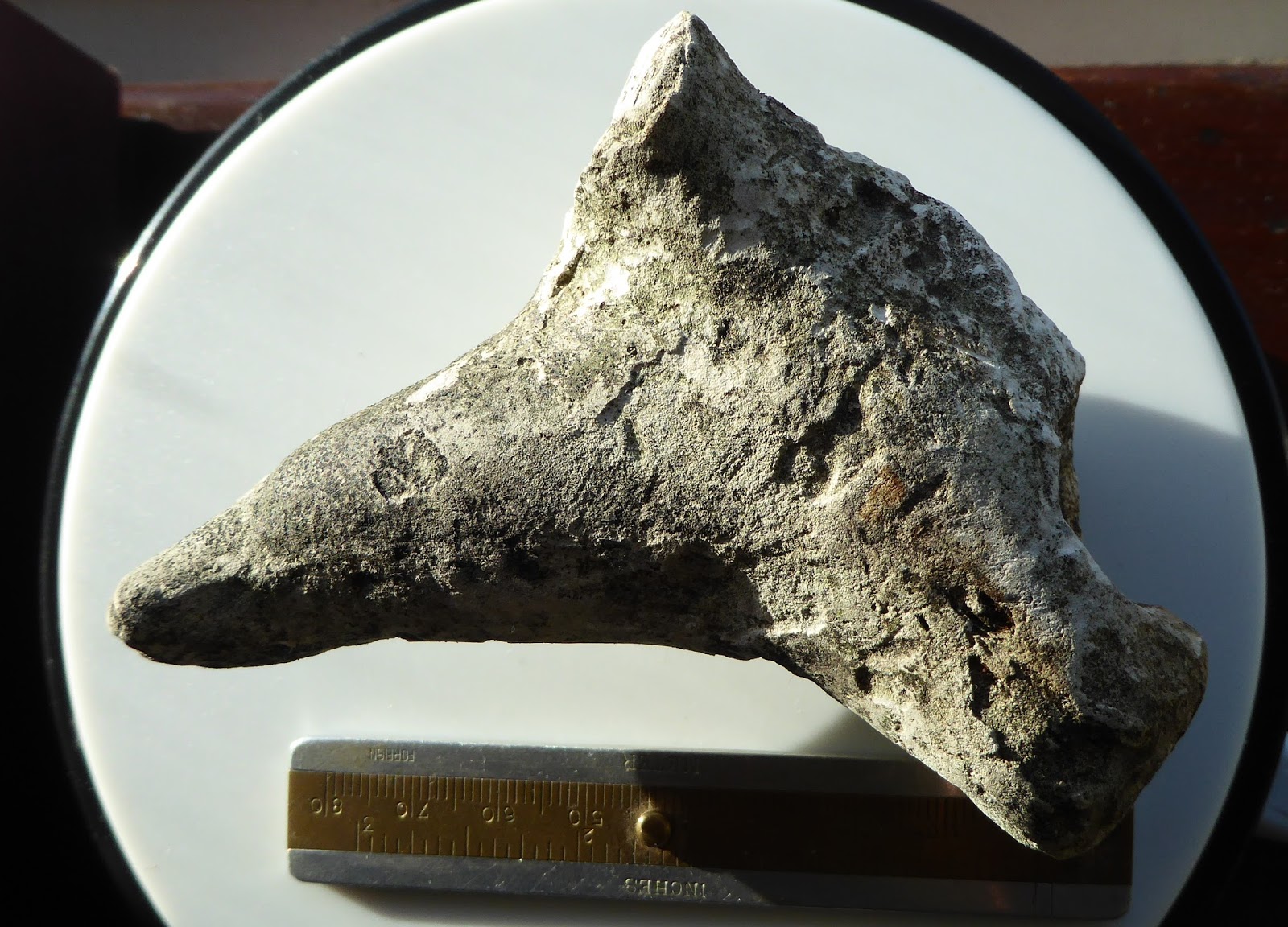
 This foot print shaped flint find is in a similar style to these two flint artworks also from my find site. These thin flake sculptures show possible signs of painting (the white areas) and are quite small, this one being just over 2.5 inches toe tip to heel.


Figuratively foot, leg and boot like descriptions can be found in figure stone or portable rock art pieces, see the post Portable Rock Art - Flogging a Dead Horse?  many of the head profile descriptions can be flipped over to describe a foot or boot. This foot print shape also adds more evidence that ordinary humans were responsible for these artworks.