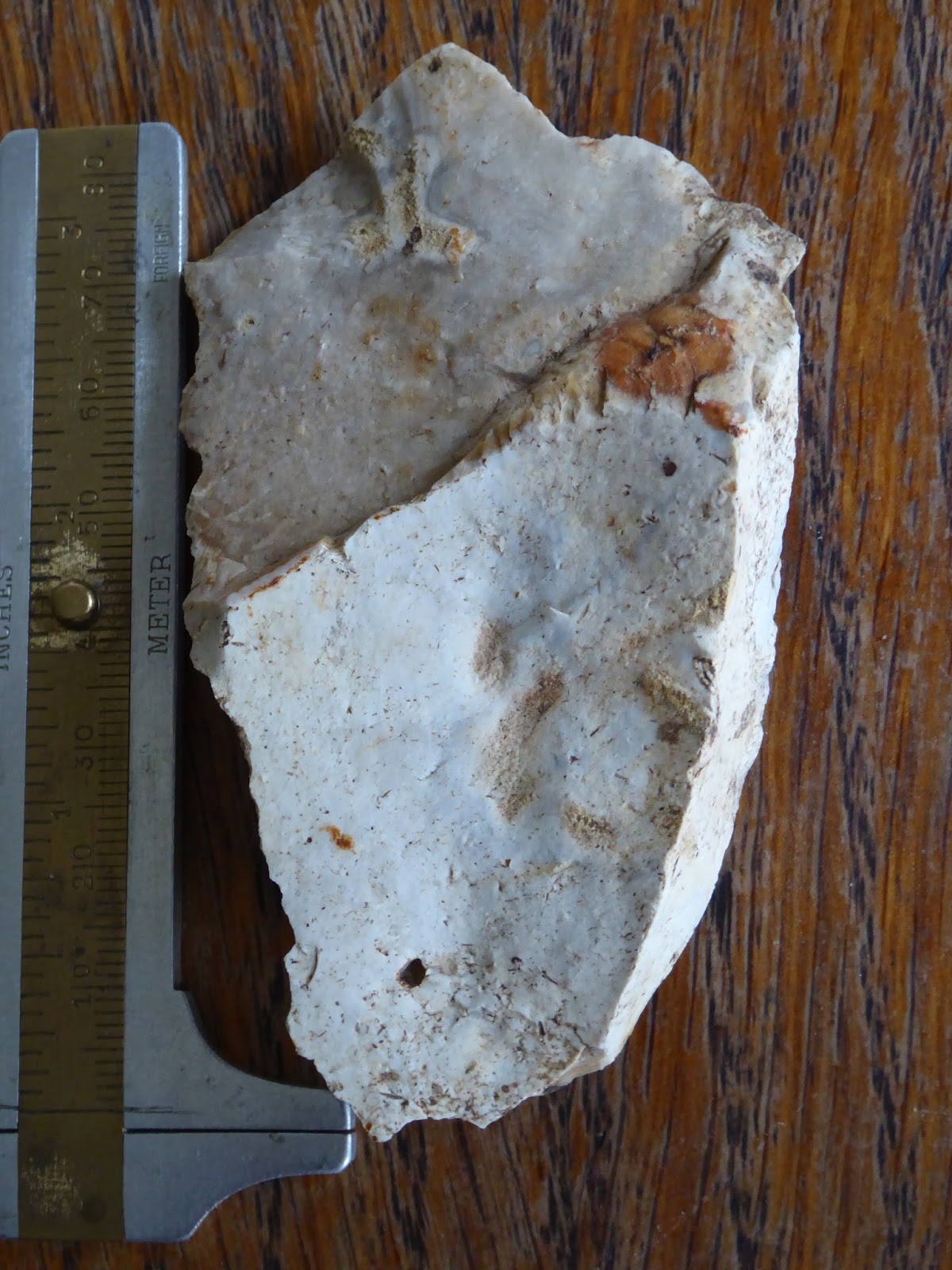
This find recovered from a stratified cretaceous chalk cliff appears to show a depiction of a Tyrannosaurus Rex or similar creature. The chalk this was recovered from was laid down over 66 Million years ago making this an eolith. According to popular science theory their were no humans around at that time to create this artwork.
So what makes me think this find shows a dinosaur image? Well.... the usual 'triggers' or features that I have recognized in other dinosaur like impressions are all present. The large oval nostril, large tooth shape shown protruding from the mouth, the ridge just above the eye, and the overall head profile shape all add up to create a good impression. Oh and I did recover this from layers dating to when such creatures roamed the earth, from a site that has produced some of the worlds most stunning, detailed and topologically consistent prehistoric flint artworks.
Above: Other depictions are also most likely combined, possibly horse and wolf like impressions can be seen depending one which eye feature you choose.
Above: a horse head profile?
Above: a hominin head profile?
Above: Another Tyrannosaur head profile is shown with all the key features, also a human like hand shape can be seen.
Readers of my blog will know that on some occasions I have suggested that a form of paint or pigment has been used to form figurative impressions on flint artifacts. It's clear that ochre and tar were used in many of my finds, but what has caused the grey areas that I also suggest have been painted? Some may think they are just random inclusions in the flint, but in this flint tool find it can be seen that these gray markings are not random at all.
The small ring shapes on this flint tool are conjoined to produce lines and patterns of rings, this was probably achieved by dipping a piece of grass in pigment and applying it to the surface of the flint. The pigment has over time petrified into the calcite patina.
A simple pebble find with a simple face description, very good symmetry can be observed.
A sad looking face.
A less sad looking face when the stone is flipped over?
This find from Colin Bentham, UK, also has a face like description with some good symmetry. The eye features appear to be highlighted with an iron compound (ochre).
Do some figure stones show deliberate depictions of dinosaurs? Actually there is no reason why not. Ive already shown how sculptured flint artifacts can be recovered from cretaceous layers and I have given simple instructions on how you can easily find your own in gravel deposits, that are millions of years old. Some other portable rock art proponents may well mock at the suggestion of intended dinosaur impressions, but the fact of the matter is that dinosaur interpretations are no different from any other interpretations of suspected figure stone finds.
The head profile of a 'protoceratops' facing left?
Another 'protoceratops' head profile facing right?
This next two images are from a find by Brian Troy of New York, USA. Some of Brian's finds exactly match the topology of my finds here in the UK.
A 'protoceratops' front half facing left? The front half convention is common in figure stone finds. (frills can be seen on the collar)
An ape like face frontal can be seen in shadow to the left of the stone.
Look very carefully at the the image above. These gravel deposit finds have an obvious topology.
In order to debunk many a theory so quickly, it must be assumed that you are already very local to a stratified and date-able ancient gravel deposit predating man or even ape theorized emergence. Then simply look for the same 'thumb' shape shown above (more here). Now check for details like an even patina, the curve or nail shape of the 'thumb' tip or the 'ape like' head profile shape shown top left in the stones, or the motif shown in the previous post (here). Other motifs to look out for are the elephant head or front half motif.
If you find such a shape with the common features, then congratulations the paradigm has been debunked and most of those theories and papers about human evolution, ape emergence, and origin can be washed away. This same shape can be found world wide most likely, and points to incredibly ancient human culture. Click here to see more evidence.
This Eolith Flint Hammer Tool from Wimereux, Pas-de-Calais in France shows a whole elephant depiction. The sand
layer the item was found in was dated to the lower Paleocene, that's nearly 66MYA. Readers of my blog will know that elephant depictions are one the most prevalent motifs shown in prehistoric figure stones, no doubt due to the importance of the animal to incredibly ancient homo-sapiens. The elephant motif can be seen facing rightward and a mammoth motif can be seen facing leftward but needs to be tilted slightly clockwise.
The Australopithecus genus was believed to have evolved some 4MYA in Africa. Here are some sculptured flint artworks that may show images of Australopithecus or other similar ape hybrid forms. This motif characterized by a heavy brow ridge and hump toward the back of the 'head' can be found in many places worldwide including North America. As is the norm, all of these finds are from my site in Southern England and all show other motifs that fit the common lexicon. If the motif does in fact show images of Australopithecus then the assumption that they evolved in Africa some 4MYA is false, and they wondered the Earth at least 65 million years ago. This motif can be seen in many of my finds and in numerous pictures on this blog.
Both of the above images are of the same flint figure stone, the above still shows a black mark as an 'eye' probably birch tar, both 'eye' features are dotted with the same tar like substances. More 'tar' can be seen to the right of the still image.
This image from the previous post also shows the same motif facing leftward.
Again the same motif can be seen leftward.
The elephant head motif can be seen, the large leached ochre spot representing the eye feature.
This image is of the same stone shown in the previous two images, it is a thin flint blade tool and is shown in a free standing position.
The same motif, but can you see the whole elephant shape and dino head shape?
The above find was recovered from over a meter down in stratified cretaceous chalk layers, again we can see the same motif facing left. Video of the recovery of this find can be seen in this post here.
Bellow are a few images from my find site, as always numerous figurative possibilities can be seen, but could they show intended descriptions of crocodiles?
Crocodiles are suggested to have swam in the shallow seas of Europe as far back as 152 million years ago, as for when they could last be found wild in Britain? I do not know.
This small worked flint find in the above photo has a 3/4 gorilla face like image top left facing right. Head, ear, shoulder, eyes, ear, muzzle, and teeth like descriptions can be seen. A reasonable elephant head profile can also be deduced.
Above: A possible baby crocodile head motif?
The above picture is of an eolith found in sedimentary layers dated to around 7MYA. It's not unreasonable to suggest that almost all of the flake removals were executed with intent of creating a crocodile/alligator head profile likeness.
Above: A baby crocodile or frog head emerges from the water?
Above: Not much modification is shown, but has the cortex been modified to show a thumb or finger nail? top left tip.
In the last post we looked into patinas on a suspected eolith and I went through some of my observations according to my study on Eoliths and Figure Stones. In this post we will be delving into probability, particularly in parallel features and practically apply the study to some flint finds.
This flint from my find site shows two sets of parallel lines.
Many people have found these rhomboid or diamond shaped stones in connection with figure stones and I have a few from my find site here in Southern England. But is this a natural formation? No, it is not! allow me to explain a little further.
The probability of two randomly placed lines on a flat plane being parallel is zero, that's right! according to mathematics, that popular sciencey thing, there is a zero chance that two randomly placed lines will be parallel, but not impossible. Here is a thread about the boring math equation from StackExchange.
Right so we have categorically established that the stone above is not a natural formation, we have a next to impossible appearance of parallel lines twice in the same find, here is my simple version of the math:
A nearly impossible probability multiplied by another nearly impossible probability equals a very very very impossible probability.
But can this be applied to other linear features or alignments in flint finds and eoliths? Yes it can. When face features are in an upright alignment to each other exactly the same math applies, although that does not account for the random creation of a face like feature in the first place, adding an even bigger statistical unlikelihood of it being a natural formation. Readers of my blog will already be aware of face and other features having linear alignments in my finds and most likely there own.
Applying probability and statistics to linear flake removal is another useful tool in debunking eoliths as natural formations, below is a picture featured on Adam Bentons web page Evoanth, quite what or even if he was thinking when writing this post, I do not know?
The eolith is left and accepted tool on the right.
The picture comes from this scientific paper about eoliths here.
I count four linear flake removals (not including retouch and sharpening flakes) in the eolith, one on the reverse (first drawing) and three on the front (second drawing). But these are not perfectly parallel? No, but they are as near as damn it, and we have a third factor to work into our equation, that of depth, our z coordinate, as our flakes (or lines) are not locked to a flat plane as they are in the equation, but we can ignore that as it would only add further improbability, and a probability of zero is already unbeatable.
There are more things worth noting, firstly, creating a nice long linear flake removal is very difficult, and I am sure many a skilled flint knapper can tell you that, so that's unlikely to be caused by a falling rock or a trampling foot from the outset. Secondly the eolith looks to have been created using the levallois technique, a well known prehistoric process for creating flint tools, the shape created as part of the parent stone, and then removed with one blow to produce the tool, ready for retouch and sharpening.
So what can we conclude? Many prehistoric flint tools have been ignored and labeled as natural formations most likely because they disprove much of the evolutionary theory of man.
I recently came across this article on Rutland County Museums web page showing a picture of a suspected eolith, so I contacted Lorraine Cornwell the museums collection manager asking for more details. Lorraine kindly provided measurements, additional photographs and any other details she could find:
Part of the Oakham school collection.
Suspected bronze-age flint hammer stone.
Reassessed as a natural formation.
Dimensions, Length 140mm Width 90mm Depth 50mm (approx)
A subtle elephant motif can be seen facing left (possibly in half or seated configuration) and a partial thumb and nail motif to the right.
When I first saw the picture on the web page I instantly noticed some possible figuration, that of the seated elephant motif and the partial thumb and nail motif. Regular readers of my blog will already know that the combination of elephant and hominid motifs pretty much defines the figure stone phenomena, weather as whole or half elephant, thumb or hominid face profile, an elephant front leg and hand combination can be seen here.
Thanks to the additional pictures provided I decided to examine this 'eolith' further, to see if it was either a flint tool, a figure stone or just a natural stone with some random flake removals.
I noticed four distinct patinas created by time and flake removal, this was a concern at first, however the patinas all seemed to fit into four separate chronologies, here is what can be observed:
The original cortex of the flint, created when the nodule was formed underground in chalk deposits. (Oldest, Very Ancient) Please note the ocher etching on this surface, inscribed at a later date.
The cortex on the flint eolith, a head profile shape can be seen on the right facing left, small chips to the cortex making the eye, nose, ear, mouth and chin features.
The 'thumb nail' area has a very thick patina on the surface. Created by one flake removal, and another surface below with matching patina from another flake removal. (Very old)
The thick patina can be seen to the left. A front facing head shape can be seen in the micro flaked surface bottom center, slightly left.
The majority of flake removal creating the objects defining shape is of another thinner patina. This surface also defines all of the suspected figuration and the patina matches the edge blade sharpening features. (Old)
Sharpening flake removal can be seen all along the edge to the right, an ape like face profile can also be seen upper right facing right, and a 3/4 human like face profile top right facing right.
Many tiny flake removals in one localized area, having next to no discernible patina (through use as a bronze-age hammer stone?) (Relatively modern)
Lower center we can see some more modern small localized flake removals.
The final area of note is that of tiny scaly flake removals, this to me looks very much like that on burned flint, often found in fields of known prehistoric activity and usually described as pot boilers. (Flints heated in a fire and then used by placing them in cooking vessel to heat or cook food, (ancient clay or wooden pots could not withstand direct placement on a fire))
Lower center area looks like it has been burned, very much like a pot boiler.
The post was written in order to practically demonstrate my use of flint analysis as described in the previous post Eoliths, Flint Tools and Figure Stones. So is it an artifact, a flint tool, a figure stone, or not? Tell me what you think.
Eoliths and Figure Stones, destroying myths of pareidolia and natural formation.
This article intends to be an aid in recognizing genuine worked flint stones, eoliths, stone age tools and figure stones. It also addresses the common misconceptions in mainstream archeology that puts forward the opinion that many genuine artifact finds are nothing more than random anomalies produced by nature.
This article is mainly dealing with observations of flint,
particularly in the areas of flake removal and patinas, although much
of this article can be carried over to other materials, and the topological, figurative and probability observations stand on there own.
So what are Eoliths?
The word eolith comes from the Greek, eos (dawn) and lith (stone), so dawn stone. They are stones that can be found in ancient layers that supposedly predate human or hominid emergence and resemble worked stone tools or figurative depictions. Many eoliths have been recovered and put forward as stone tools, but the current mainstream belief is that these are nothing more than a natural phenomena, natural environmental factors having made recognizable shapes by random chance.
In simple terms what we are dealing with is a complete contradiction
of mainstream archaeological theory in the field of palaeoanthropology.
As many eoliths are indistinguishable from other stone tools and can be found in layers predating accepted mainstream theorized human and ape emergence, by many millions of years.
The drawing on the left is of an eolith, and to the right an accepted flint tool. Readers of my blog may recognize the eolith's figurative topology, although subtle we can see the elephant and front leg depiction, and a concise thumb shape. This is clearly not a natural formation.
(Elephant and front leg depictions can be found throughout the materials displayed on this blog and this is a link to my theory on thumb shapes:- Rule of Thumb, Portable Rock Art)
Figure stones, sometimes known as pierres figures or portable rockart, are stones that show figurative resemblances, most often of creatures, commonly elephants, birds,
bears, felines, apes, monkeys, hominids and humans. They show evidence of working and modification
and are thus believed to be manufactured by ancient humans.
Many believe figure stone finds they have found to be genuine
prehistoric artworks. In many cases it can be demonstrated that these are in fact genuine worked stone
artifacts, which do indeed show numerous figurative descriptions. For the most part mainstream
archaeology does not accept them.
In the case of figure stones, accusations of pareidolia or
apophenia are put forward to dismiss figurative observations in finds as being imagined and not
deliberately created. ‘your just seeing things, your mind is playing tricks on you’, ‘nothing to see here, move
along’. Natural excuses are also put forward to dismiss them as
artefactual.
Figure stones can be a contradiction to mainstream theory as the
creature motifs depicted can fall out of time line with the theory of the evolution of man and the emergence
of cognition producing the oldest figurative works of art.
To long won't read?
In short many Eoliths are genuine stone tools found in tertiary layers, They are no different from other recognized stone tools accepted and on display in museums all over the world, the only difference being is that these are not in line with current evolutionary theory, ape and man emergence timelines. Topology, flake removal, blade retouch, bulbs of percussion and surface patina prove they are genuine artifacts and not geofacts. Many figure stones are also genuine pieces of prehistoric art, many observations prove the validity of my own finds, the most potent of which is topology and probability, but flake removal and deliberate modification also prove they are artifacts in there own right. So accusations of pareidolia can be instantly dismissed, the objects have been manufactured, if its not a picture of an elephant then what is it?
Lessons for mainstream palaeoanthropology and archaeology :-
When the facts don't fit the theory, don't dismiss the facts but change the theory.
O'rly? So Eoliths are genuine artifacts?
Firstly I am not going to claim that all stones that have been recognized to be tools or sculptured figure stones are genuine artifacts, however nearly all that fit my criteria and recognized topology are genuine stone tools or prehistoric works of art.
Flints that show flake removal, retouch and shape topology have been dismissed in archaeology and palaeoanthropology as a natural occurrence. Environmental effects such as, trampling, geological stressors, tides, wave action and other means are claimed to produce tool shapes, these often appear to show blade flake removal, and shape adherence no different from other recognized flint tools. There is no evidence that natural effects can or have produced stones that would otherwise fall into the category of worked stone tools.
Debunking the archaeological stand point of 'Eoliths are natural formations.' and images on Figure stones as pareidollia . We are going to examine patina, flake removal, topology, probability, pareidollia , tar and ocher.
Signs of working and modification?
Two common stand points for assessing flint objects as being worked are the presence of these:
1. Bulbs of percussion and con-cordial fractures.
2. Repeated flake removal scars on the flattened surfaces of the flint.
Unfortunately it really is not as simple as that, although they may both be good indicators for some standard shaped tool production, many modified stones do not have those indicators. Here are some problems with only using those two 'rules' to assess flints as artifacts.
1. Not all flint modifications are 'standard', cortex removal and sculpting do not show bulbs or con-cordial fractures. Grinding to produce cupules or holes does not produce con-cordial fractures or bulbs of percussion.
2. Bulbs of percussion are often made as a result of large flake removal, the basic shape of the tool being made with a blow to a prepared area of the flint. Not all worked stones fit that basic tool shape topology, and the basic shape is not made with a single large blow producing the bulb of percussion.
3. Con-cordial fractures can be covered by patinas, the ripples are covered by a build up of a thick layer on the surface of the flint.
4. Many flint tools recognized as such and in museums or collections do not show bulbs of percussion.
5. Repeating flake removal scaring on flat surfaces is about thinning, shaping and sharpening of a common tool shape, not all working in flint is aimed at producing those shapes, so those repeating flake scars may not be present.
Other signs on artifacts?
I have observed iron patches, etchings and staining on many flint
tools, this is not there by chance, I usually refer to this as ochre,
as it covers all of the types of this material, weather from applied
natural deposits, iron pyrite, prepared materials or iron rich
meteorites. Prehistoric peoples are well renowned for there use of
ochre, and patches,
etchings or staining can be found on the majority of recognized
prehistoric flint tools of certain age.
The photo of this fossilized echinoderm shows an example of ochre etching, the dark lines in the center of the fossil were produced by sustained force in multiple strokes from an iron rich 'stylus'. This surface find was likely dug from deep chalk deposits while mining flint, this type of fossil has other uses besides decorative or figurative, they make excellent hammer stones.
So
why are ochre
etchings on flint a sign of genuine artifactuality,
and not there by random chance? Quite simply, sustained, localized, and precise linear pressure
from an iron rich source needs to be applied to the surface of the flint in order to produce an ochre
etched line, this is clearly not a natural phenomena, and many times there are many such etched lines on
individual finds.
This flint tool shows a manufactured ape face description, the eye shape is made up of numerous tiny flake removal scars, but has a form of paint been used for the other more colorful areas of the face? The paint now being petrified into the patina? Numerous examples of finds like this from my site would suggest so.
Another common feature in my figurative finds is the presence of what looks to be a tar like substance, prehistoric people are known to have made birch tar. This appears to have been used as an aid in figurative design, rather like we would use paint today but also applied and etched away.
The distance from ear tip to trunk tip (which are the longest dimensions) were measuered A, 76mm, B, 72mm C, 75mm. Differing techniques were used in the creation of the eye shapes, as follows: A, ochre etching and flake removal., B, exploitation of natural inclusion and flake removal., C, Many tiny flake removal scars and application of a tar like substance.
Patina on genuine artifacts, and examining flake removal.
Patinas
naturally build up over large time periods on flint surfaces, this is
one key feature in determining
validation of flint objects as manufactured, and ruling out almost
all natural excuses in tool shape
creation from these stand points.
1.
Flints are naturally formed in nodules, chalk sealed, these being
completely cortex covered, so any flake
removal of the cortex would indicate some kind of physical action in
order to have done so, natural
or intended. These show little evidence of large flake removal, or
disturbance and all broken pieces
are present, although breakage would be uncommon.
2.
Genuine artifacts should have a mainly coherent patina, not many
differing patinas on differing surfaces.
However, sometimes a stone can be rediscovered, reworked and reused,
which can cause anomalies
in patinas, this would not be a common occurrence.
3.
An even surface patina on removed surfaces suggest no flake removal
since the original occurrences having
happened. So a patina has built up with no further flake removal,
over some considerable amount
of time.
4.
Probability rules out a sequence of natural events having produced
multiple flake removal scars in one
proximal time period, as
no further flake removal scars have happened since. Multiple flake removal
scars having happened in one small and distant chronology.
5.
The fact that another ‘natural?’
occurrence of flake removal is absent from such ancient pieces would indicate
that random chance, and natural flake removal on flint pieces is
rare.
6.
Crashing wave action or water flow rolling flints produce a worn
effect where tiny flakes are removed
over large periods of time, shapes are worn to produce pebbles, they
are evidence of absence of
large flake removal, and close sequences of large flake removal
events due to crashing waves, tide action
and friction in these conditions.
7.
Erosion, removal or a violent gravitational effect on flint nodules
from any resting place would also be a
rare event. If a flake or sequence of flake removal scars happened,
patinas would also encapsulate that
event. Linear and logical flake removal does not happen in this way.
This can be tested, if someone was
to repeatedly drop nodules off cliffs or roll them down hills,
although that in itself would be intent and
agency, and not a natural event.
8.
Trampling and plow damage, marking or flake removals have been found
to be rare events.
9.
Glacial fracture events, temperature, ‘starch fracture’ damage
could be investigated but I believe theses
are largely false, surface finds are very rare where they should be
common. There are glaciers today,
yet nobody is witnessing linear flake removal, or scale frost damage.
Conclusions on patinas.
Flints
contain stratigraphy in the form of layered patinas, breakage events
leave chronology, the more absent
the patina build up being the most modern break or chip event.
These
flint tools from my find site have some damage, a flake has broken
off revealing the underlying flint
material and the thickness of the patina. This kind of flake removal
event is very uncommon in my finds
. From my observations of flint tools of certain age, patina build up
is a very slow process, microns
of thickness being formed over hundreds of thousands of years. A
thick patina like the ones shown
could suggest huge antiquity in order of tens of millions of years.
Natural
large flake removal is a rare event in flint. Collectors and museums
hold many flint tools that demonstrate
this because they have an even patina, are unbroken or further
chipped (out of a creation and
usage timelines.). Weathering, tide action and other natural
phenomena has not produced further large
flake removal. So a short succession of multiple flake removals made
the shape of the item, which then
over time was covered with a patina, the patina is unbroken and no
other effects have produced flake
removal. This counts massively towards recognizing genuine
artifactuality and we can produce statistics
for probability.
Examining Probability and Statistics.
Let us suppose a hypothetical scenario to test some likelihood of a success condition in the generation of a naturally occurring random eye shape. I will only use a few elements to simplify all possible scenarios.
Elements:
1. A flat round surface, this represents a surface on a stone.
2. A randomly placed spot shape, this represents part of an eye feature and a hypothetical circular flake removal.
3. A randomly placed curve shape, this represents the other part of the hypothetical eye feature, again an imagined natural event.
A success scenario occurs when the condition of a spot falling directly under the curve, with the curves ends downwards and diametrically adjacent to any edge of the circle. This would produce an eye shape on a head shape that could be interpreted as a simple, and almost featureless side on face profile.
If we run the test once, we can see on one circle, with one spot and one curve, a success condition is very very unlikely. If we repeatedly make random spots and curves eventually a success condition will be met, but we will see that a large number of unwanted conditions are present, hypothetical natural flake removal events. One has to wonder how often random natural flake removals happen in stones? And if they did happen, only those proximal in time would leave an even surface patina.
When we factor in other elements such as mouth, ear, nose, nostril, hair and correct shape, the likely hood of success is very minuscule. But there are millions upon millions of stones? surely one would produce the highly unlikely chance of a complete recognizable face profile? Maybe, but I don't look through billions and billions of stones to find a repeat topology in my figure stone finds, I actually collect them very quickly without to much concern for shape beyond the obvious, mainly looking for numerous flake removal, then carry them home, and check properly for figuration afterwards.
Similar scenarios can be imagined for linear parallel flake removal scars, involving imagined lines through a hypothetical sphere requiring two pairs of x,y,z coordinates, again a parallel condition is highly unlikely. Even a scenario involving three spots on a flat plane being proximal and aligned is a hard condition to reach, and would simulate and demonstrate that a natural hypothetical blade sharpening scenario is incredibly unlikely.
What is important to remember here is not only the unlikelihood of a success condition in shape generation, but the absence of unwanted features and no observable difference in the chronology of those events being visible in the patina.
From a statistical perspective a natural creation of a face depiction being present on this stone is highly unlikely, close to impossible.
Blade edge sharpening and shaping.
Violent breakage of flint can produce sharp flakes, that could be used as blade tools, however a small series of flake removals along an edge is almost certainly always a manufactured attempt at blade sharpening. Blade sharpening and retouch flake removal like characteristics do not occur naturally, suggesting that this is a natural phenomena is a akin to suggesting a brick wall is a natural phenomena. Patina consistency and individual linear flake removal scars would be very strong evidence of artificiality rather than natural phenomena.
Another flake removal scaring phenomena is that of parallel linear flake removal, believe it or not, this topology has in some cases been described as a natural formation, this goes beyond any common sense or cognitive reasoning of the proponents of such opinions, even two parallel flake removal scars are improbable of being natural.
Topology and Repeating Conventions.
The only 'naturally worked' shape topology to be found in un-modified flints are the
rounded oval shapes of pebbles. Flint tools and figure stones show there
own man made topology, this topology is proof of design and manufacture.
1. Throughout art history a repeating topology of technique is shown, that of side profiles of the subjects to be depicted, in most cases this is exactly what figure stones show, side on profiles, and not just one side on profile in each example, but many.
2. My figurative pieces contain many detailed eye shapes, these are produced by a sequence of agency effects, multiple actions in a small area to produce an eye shape, and almost always as part of a more detailed figurative description. Naturally occurring eye shapes are a rare phenomena in stones, let alone the fact that in my finds they are often accompanied by detailed ear shapes, nose shapes mouth shapes and repeating subject profiles. Eye shapes are not always flaked, in many finds tar and ocher are used rather like paint, these are both known to have been used ubiquitously by prehistoric peoples.
3. Many figure stones stand upright, and when in an upright position the figurative descriptions are also upright, this is clearly by design. Many figure stones that don't stand have upright descriptions when the stones longest dimension is vertical. Rotating the stone around its longest dimension in its vertical position often displays a series of upright figurative descriptions.
4. Many figure stones show numerous creature descriptions, each having numerous facial or bodily feature representations. These can often be recognized as being of known creatures, probability validates authenticity.
5. The same repeating subjects and popular motifs can be found across numerous individual samples, we have common theme's and this again is statistically unlikely to have anything to do with random chance.
6. Repeating combinations can be found, for example the elephant and front leg motif can easily be combined with the thumb motif, this blog has many examples of a repeating pattern of combined creature motifs across numerous samples. This is another set of unlikely probabilities that have an observable topology.
7. Over all basic outline and shape topologies are present, just compare the eolith picture at the beginning of the post to the other shapes shown in the post Rule of Thumb, some very close shape matches can be seen. These can also contain sub sets of topologies, for example the thumb nail shape and elephant eye shape being present and correctly aligned and located.
Pareidollia and Apothenia.
Many topologies, probability, flake removal, intended modifications etc. have already ruled out pareidolia as a possibility in my finds. However I have found this excellent video by Danny Wilten and other contributors, which will help educate in this field.
Conclusions.
My understanding of figure stones has led me to believe that although they are artworks in their own right showing incredible skill and forethought, they can have a more practical usage as well. Common topology of motifs, conventions, recognised combinations of shapes and a common species lexicon are observed, so in my view a visual language which can be recognized almost world wide, although that is not covered in this article. Many factors prove them to be genuine, the most potent of which are topology and probability, but flake removal, even patinas, deliberate modification and ochre and tar usage also prove they are indeed artifacts.
As for ‘eoliths’ many are genuine stone tools found in tertiary layers right through to cretaceous layers, they are no different from other recognized stone tools accepted and on display in museums all over the world, the only difference being is that these are not in line with current evolutionary theory, ape and man emergence timelines. These can also have figurative content. Topology of flake removal, blade retouch, bulbs of percussion and surface patina prove they are genuine artifacts and not geofacts.
Many eoliths and figure stones are manufactured items, the details and points raised in this article prove it beyond any shadow of doubt. I also have video evidence of an artwork find being removed from stratified layers dating well into the cretaceous period, that's over 65 million years old according to scientific dating of the layers. Not only that, the find is part of a recognizable and repeating topology, an artifact in its own right, just like a bike, a wall or a mobile phone, the item is manufactured and conforms to an observable set or rules.
Figure stones are a sculptured record that contain a vast wealth of information about fauna in any given stratified layer, archeologists, paleontologists and researchers who wish to know the truth about our distant past would be fools to ignore such detailed environmental information.