
Saturday, 11 April 2015


Thursday, 18 September 2014
Prehistoric Clothing
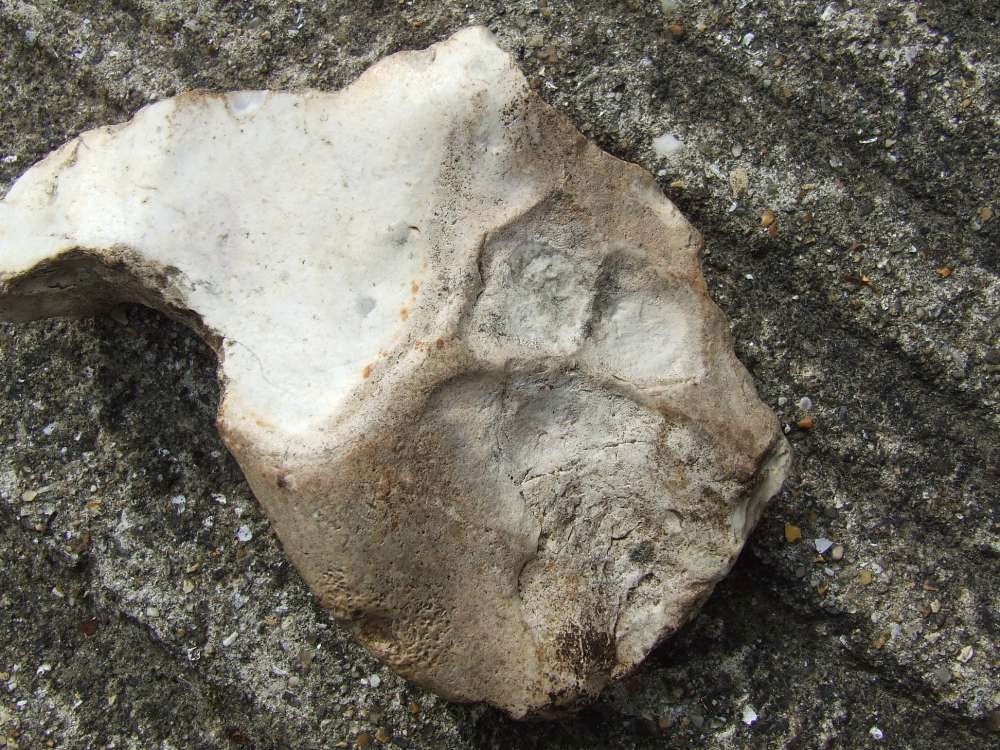
This curios flint find is from my site and is in the more usual white interior, light brown cortex covered material. I suggest that cortex removal technique has been used here to produce this calving of a human arm, sleeve and pointing hand.

On the reverse side of the stone there appears to be a black tar or resin like substance covering the cortex, and some apparent scratches have removed this coating. If this substance has been intentional used, and is organic, then there is a good possibility that C14 dating is possible here. I have a few possible examples of this, but iron pyrite is more notably used for etching and detailing, and I have far more examples of that.

On the reverse side of the stone there appears to be a black tar or resin like substance covering the cortex, and some apparent scratches have removed this coating. If this substance has been intentional used, and is organic, then there is a good possibility that C14 dating is possible here. I have a few possible examples of this, but iron pyrite is more notably used for etching and detailing, and I have far more examples of that.
Thursday, 14 August 2014
More Optical illusions

All images from the same stone as the previous post, yes the stone has more too!, here we see a gorilla walking to the left.
.

Very complex and vague imagery can be seen here, a good front half of a bear is traveling right, another elephant half can be seen facing right as well, i suspect a bison and maybe another lion, i cant seem to bend my mind enough to see them yet. Another elephant head can be seen looking left with trunk curled upwards.

Same gorilla head different body pose, and the head of a feline? looking right.
 There is a lot to see and take in here, so i have included some stills to make viewing more easy.


(above) The front of an elephant looking right., A possible bison shares the same eye as the elephant.

(above) a human face profile looks skywards a hominid face looks right.
Friday, 1 August 2014
Prehistoric Faces
(above) The front of an elephant looking right., A possible bison shares the same eye as the elephant.
(above) a human face profile looks skywards a hominid face looks right.
All images from the same stone as the previous post, yes the stone has more too!, here we see a gorilla walking to the left.
.
Very complex and vague imagery can be seen here, a good front half of a
bear is traveling right, another elephant half can be seen facing right
as well, i suspect a bison and maybe another lion, i cant seem to bend
my mind enough to see them yet. Another elephant head can be seen
looking left with trunk curled upwards.
Same gorilla head different body pose, and the head of a feline? looking right.
Friday, 13 June 2014
Rare clear quartz tool finds
Unbelievable quartz pieces brought to our attention by Bruce Cox of North Carolina. Bruce says 'A boy, Travis, had found the first piece and alerted me to the site, where i found the second very similar worked piece'.
These are some amazing pieces, and ceremonial use may enter ones mind as the uses for these very bling tools, on the other hand the second piece appears broken as though used, so maybe the use of the material is more a practical one?. The first piece stands 3 1/8 inches tall, the second 2 inches tall.


.JPG)


These are some amazing pieces, and ceremonial use may enter ones mind as the uses for these very bling tools, on the other hand the second piece appears broken as though used, so maybe the use of the material is more a practical one?. The first piece stands 3 1/8 inches tall, the second 2 inches tall.
Wednesday, 4 June 2014
American Paleo Tools
These three tool finds by Bruce Cox were found in North Carolina, USA. These were found in close proximity to figure stones, on the same site, in fact quality and density of figure stones led Bruce directly to these amazing paleo finds.
The American Early Paleo period runs from 12,000 to 14,000 bp, being the oldest recognized inhabited period of North America, view's are rapidly changing and many now believe that America was inhabited in an earlier period.
.JPG)


The American Early Paleo period runs from 12,000 to 14,000 bp, being the oldest recognized inhabited period of North America, view's are rapidly changing and many now believe that America was inhabited in an earlier period.
Above, A combination bird/mammoth sculpture find by Bruce Cox, from the same location as the tool finds.
Bruce Cox would like to extend his thanks and gratitude, not only to myself, but too Tim and Dennis Moore of the SDM site, for pointing him the right direction, general helpfulness and for being good friends.
Wednesday, 21 May 2014
Oval Biface
This oval biface scraper came from my site, as with all of the white material posted on this blog and Revelation in Stone website.The oval is encircled in possible hominid and ape face impressions, many are subtle and hard to catch on camera, and rely on a little imagination. My suspected date for this tool is 150,000 bp.

Above, an elephants head impression can be seen facing left.
.JPG)
Above, A good 'proto-human' profile can be seen looking left, and a weak head shape right.

Above, A gorilla like face profile looks right, and the elephant head on the left can now be seen as the front half of a bison facing right.

Two more face profiles look left.

Above, the left side can be seen as a stack of face profiles, starting with a baboon at the top.

The biface is very thin.

A suspected horned creature looks right.

Another suspected horned creature looks left.
Monday, 19 May 2014
Elephant and front leg again!
This piece comes from my site and is in the usual white flint material, working is very obvious on the elephants leg.

Friday, 9 May 2014
Mesolithic Pick
This pick is most likely of a Mesolithic date, it was found along side other tools of its suspected period, some of which have been professionally recorded in the PAS database www.finds.org.uk
As with many prehistoric tools, there are small iron deposits, and iron staining in various places, this is usually found along the high ridges, where flake removal scars intersect.


As with many prehistoric tools, there are small iron deposits, and iron staining in various places, this is usually found along the high ridges, where flake removal scars intersect.
Above, Quite a good horse head impression can be seen looking right
(Above) A weak, but seemingly intentional bird can be seen facing right.
(Above) there is a worm fossil running right around the pick.
(Above) An imagined face looks left?
Friday, 28 March 2014
Talking Stone
This stone appears to show a modern human face, facing both left and right and also the best gorilla head profile I have seen to date, with a little work many more of the common glyphs can be found in this piece.
 Above the gorilla head profile looks left, another ape can be seen if the gorillas nostrils are imagined as eyes.




Human face looks right.
Human face looks left and elephant head looks right.
A feline face looks right.
The Gorilla looks left, the horse head right.
The Bird.
Wednesday, 19 March 2014
Between a rock and a hard place.
I
have been concerned
by the quality and authenticity
of many supposed portable rock art finds sprawled over the internet. Although analyzing and
describing these stones can be very difficult,
on the whole the stones should speak for themselves, and
any genuine piece should have glyph content all over it. In
some places
I have seen some obscure rocks that bare little
resemblance to there
descriptions and scribblings
over the photos, which only
adds more doubt to the stones
authenticity. (if
a picture needs to be drawn, the rock is
obviously deficient, and would not serve the supposed
intended purpose.)
Interpretations
of animals and hominids is another grey area, we can never be certain
of what we are looking at, even if it looks like a human, it
certainly does not mean it is, and nobody can ever prove it. Apart
from finding these things in sit tu,
our only clues about the date of these artifacts
is the species, and these can be hard to
interpret, most of all when dealing with humans, apes and hominins.
So again it is better to be vague in these areas
and let the images on the stones speak for themselves.
Continuity
in finds should also be of concern, finds should be comparable across
collections, materials should be the same, if not
similar, obvious working
marks should be present, important
subjects like elephants
should be repeated throughout the assemblage with
other repeatable glyphs present too, when dealing with them
as a collection, which
of coarse is the only way to shed any real light on them.
A
word on Religion, shamanism, and deep
space alien’s in old
paleolithic times, when on
the subject of portable rock art, these are just fantasies of the
mind and nobody has one shred of evidence to support these kinds of
claims, apart from a few not so old 'Venus
figurines' there is absolutely nothing to learn about religious or
shamanistic practices, so why even bother? There
is a little to learn about cultural traditions in the artifacts
themselves, but this will tell us very
little of the people themselves. What these
objects undoubtedly are is tools, communication tools more
specifically, which is hard to take on board at
first, until you consider that
at some point in our history people were
unable to verbally communicate with much meaning. If your suspected
portable rock art has no use in this way as a tool, then forget it,
its a rock and probably nothing more.
But on the
whole I would say that the majority of finds presented to myself
by collectors are most likely genuine artifacts,
and many people are furthering the study and do
know whats going on here,
Thanks in this department
go to Bruce Cox, Roger
Pascal, Dennis Moore, Ursel Beneckendorff
,
Keith
Stamper, Charles Belart and Athena Cumpton.
Monday, 27 January 2014


Monday, 13 January 2014
Biface flint scraper.
Simplistic glyphs seem present in this blade/scraper tool. Suggested, elephant head, weak gorilla head, human head and the head of horned prey creature.


Subscribe to:
Posts (Atom)