Showing posts with label prehistoric animations. Show all posts
Thursday, 8 February 2018
Monday, 20 February 2017
Portable Rock Art - Flogging A Dead Horse?
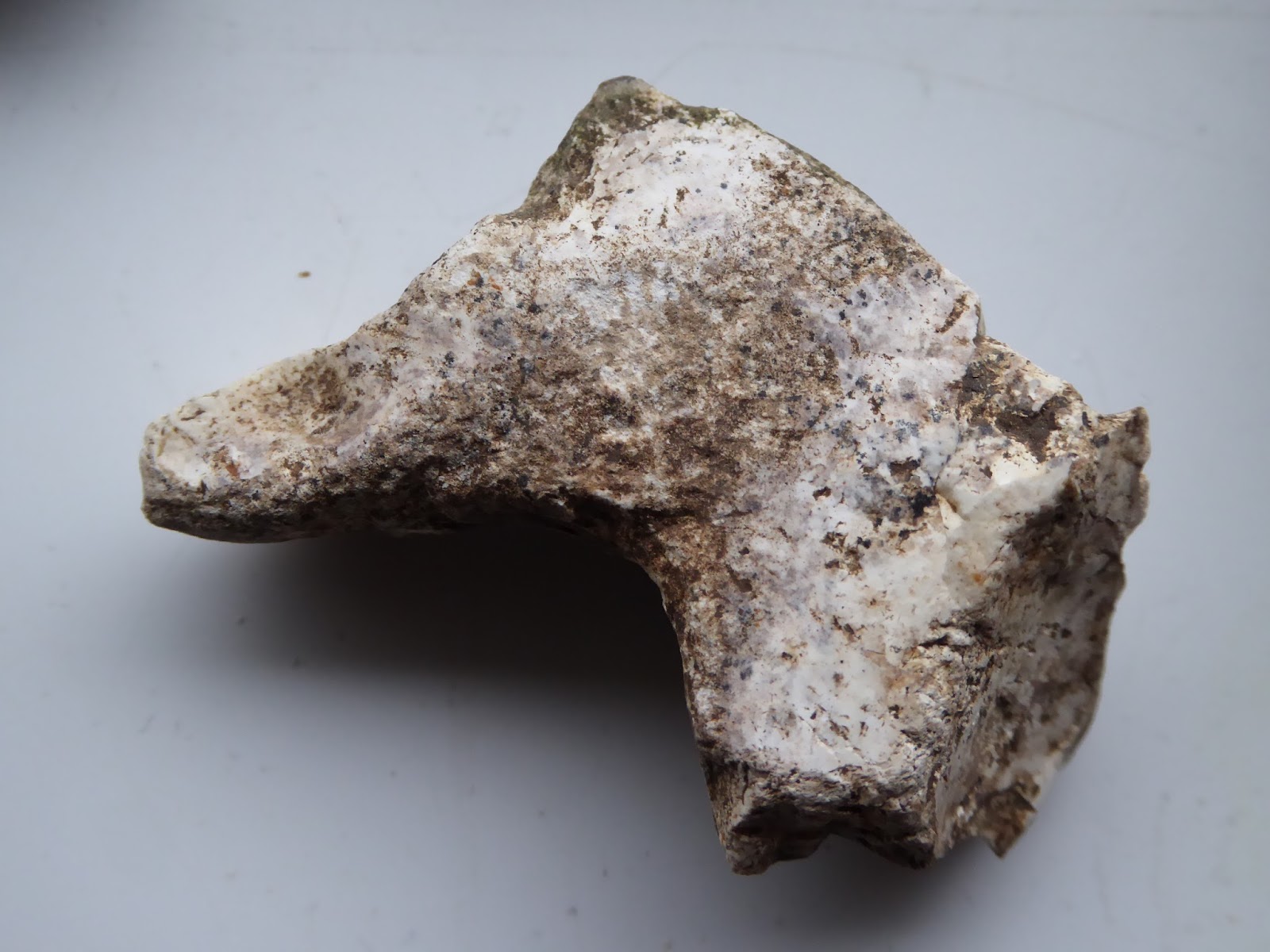
Today's Eolith's post on Portable Rock Art is about horse head motifs, these all come from my usual find site. I have shared quite a few figurative examples of worked stones showing suspected horse artworks.
In this old post, the horse head motif almost instantly turns into an impression that looks very much like the head of a Tyrannosaurs Rex (The theory of revolution) and there are more extinct creature impressions to be seen in the stone as well (UK Tortoise - extinct for roughly 35 million years)
One of the key features of the horse head motif found in my figure stones, is the 'mane' feature, many of them have it. Perhaps this is one of the key visual indicators, or 'triggers' used to produce the impression for these prehistoric peoples, or just to make a distinction between another creature with a similar head shape?
The uncluttered flint sculpture below shows the second 'eye' feature just above and to the left of the other one and, also a curved 'muzzle' and 'mouth' impression (mouth along bottom edge), this leaves us with four possible combinations, or ways to view the suspected creature impressions. Pick an 'eye' and pick a 'muzzle' and see for yourselves.
This piece from the previous post is not quite right either, mane, muzzle, ear and profile shape features are all good, but when it comes to choosing a feature for the 'eye' nothing seems to quite fit properly, and we end up with either a dinosaur head impression, or art intending to show the head of an eagle, or something like it.
A very good horse head likeness can be seen in this flint tool, this artifact contains many other motifs, just like almost all the finds displayed on this blog.
One of the key features of the horse head motif found in my figure stones, is the 'mane' feature, many of them have it. Perhaps this is one of the key visual indicators, or 'triggers' used to produce the impression for these prehistoric peoples, or just to make a distinction between another creature with a similar head shape?
The uncluttered flint sculpture below shows the second 'eye' feature just above and to the left of the other one and, also a curved 'muzzle' and 'mouth' impression (mouth along bottom edge), this leaves us with four possible combinations, or ways to view the suspected creature impressions. Pick an 'eye' and pick a 'muzzle' and see for yourselves.
This piece from the previous post is not quite right either, mane, muzzle, ear and profile shape features are all good, but when it comes to choosing a feature for the 'eye' nothing seems to quite fit properly, and we end up with either a dinosaur head impression, or art intending to show the head of an eagle, or something like it.
The worked flint piece below, shows the double sided impression of a seated horse.
The next two pictures are of the same find, I believe the item was hafted using the hole shown in the second picture. Although that would produce something similar to an axe, I'm not of the opinion that it would be very useful for chopping trees, and was more likely a weapon, the blade area is on the lower area of the 'mane'. The photo below is lacking many details, only one of which is the ocher etched 'eye'.
Below are some more worked flint finds from my site, many do seem to roughly translate as to being the horse head motif, although they could just as easily be descriptions of other creatures, some look more like dinosaur impressions or possibly other creature motifs.
Thursday, 16 June 2016
Prehistoric Animated Robed Figurines
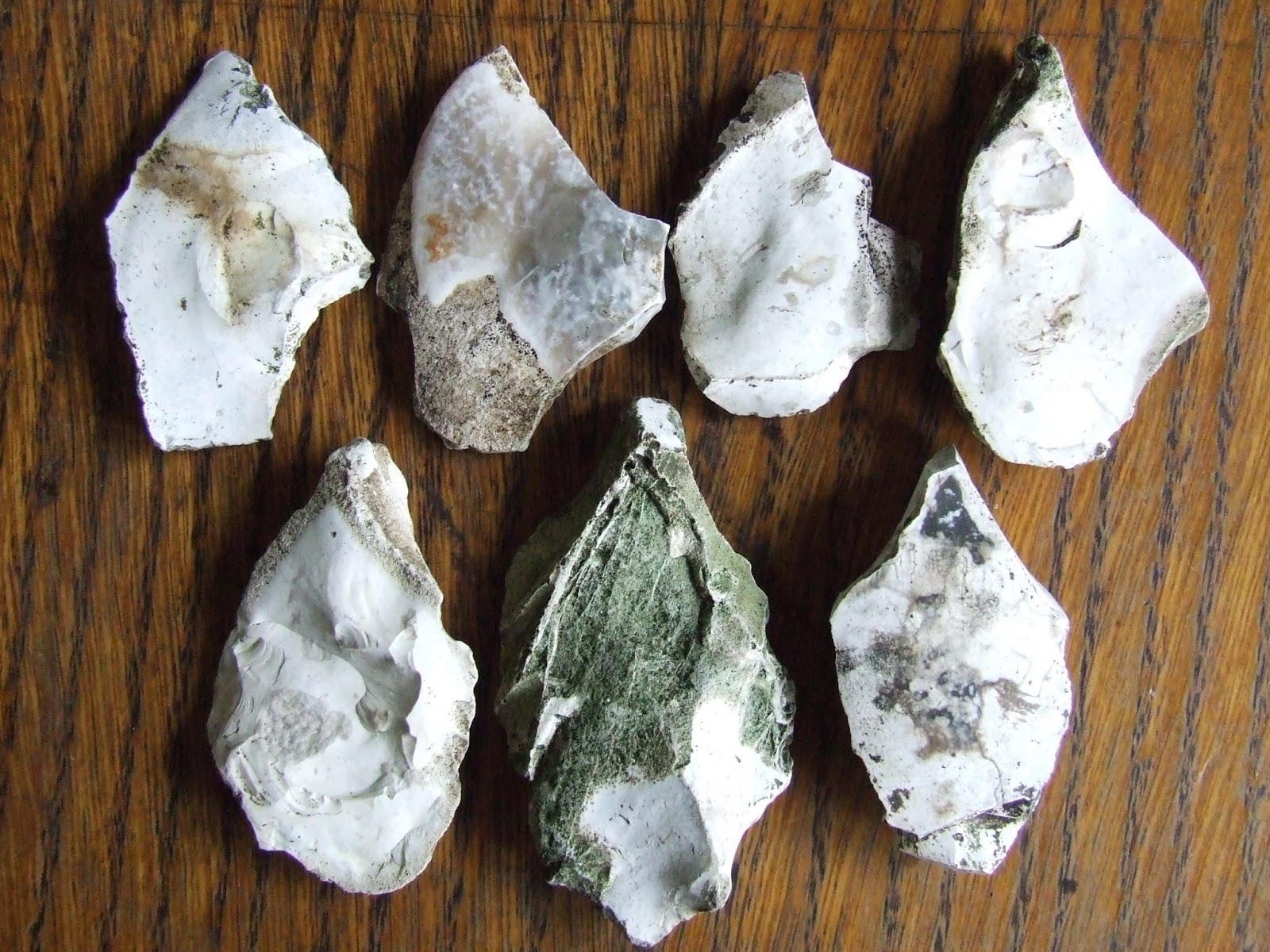
A selection of seven recent flint finds from my site collected from my last two visits. All can be manipulated in the hand to show an animated cloaked figure likeness, as though walking both right and left. They all share some common characteristics, the four shown in the top row (pictures at end of the post) have a protrusion to one side, this can be used as a lever to rotate each piece in the hand to create the animations. I've long theorized that many of these artefacts are held between thumb and forefinger and rotated with the middle finger in order to reveal the hidden animations, the side protrusions can be used in exactly this way to rotate the pieces clockwise and anticlockwise in order to create the walking figure effect. Other common features seen here are a double chevron in order to describe the hood of the robe and a downward slant from the top of the hood to the front, the point of the hood becoming an axle on which to rotate. This topology can most likely be found in hand axes and other flint tools.
Although these finds are not the the finest of modified flints from my site the visual impression they can produce is more than adequate to describe a cloaked figure walking both left and right. These are not my only finds that show walking animations. The stone featured in this recent post Standing Cloaked Figure could also be manipulated in the hand to make the stone describe a figure walking both left and right.
Above a prehistoric robed figure likeness is shown walking rightwards.
The same flint artefact as shown in the previous animation, this time as though walking left.
These next two animations from the same flint find also show a similar cloaked figure likeness, again as though walking both left and right.
Above, this stone also seems to have a subtle walking hominid impression, as though walking right, as well as the cloaked figure animations. Its not as fine as an artwork as this gorilla animation from omniglyths, which I also suspect could be manipulated in order to produce a walking like effect. Another more skilfully animated gorilla impression can be seen in the old post Prehistoric Optical Illusions.
Above and below, two more walking robed figure animations from the same worked flint find.
Above and below, stills of the seven recent finds, look for the double chevrons on the hood features, this is one of the keys in creating the impression.
Subscribe to:
Posts (Atom)