Showing posts with label lithic implements. Show all posts

Wednesday, 12 August 2020

Figure Stones - Cloak and Dagger - Prehistoric Art

 Cloaked figures and thumb/finger shapes are probably the most common artistic impressions to be found in the world of figure stones and portable rock art. Both of these motifs also bleed into flint tool assemblages found world wide, but the archeologists involved are often completely ignorant of the artistic images concealed in the flint tool finds, and do not realize that the flint tools also contain prehistoric art.

Take these relatively recent finds from India that apparently challenge the theory of evolution, looking closely through the finds I notice a few that I would classify as the cloaked figure and one that matches closely with the Thumb motif. I have used scientific method to prove that what I describe as the cloaked figure motif goes beyond just a tooling shape, but also appears in finds with no apparent cutting proposes. This means that the shape has a use that is not as a standard tool, logically a figurative explanation is apparent when one studies the details of finer examples.

Read more about the Indian finds here: Indian Stone Tools Unearthed


 The above animation gives a good impression of the cloaked figure motif, although its design is fairly simple, some face like details are visible.


 The Animation below also contains a good figure impression likeness, but look for the finger and nail motif.

 I suggest you zoom in and study the images below close up to see the finer details, the 'nail tip' also has traces of pigment.

 This next find not only triggers the cloaked figure but also again triggers the digit with nail,  I suggest thumb in this case.


The second in the sequence matches a thump of finger motif very closely, face details are also present in a few here but I suggest you look very closely at the last one. You may also notice the impression of an arm, hand, and cloaked sleeve in the last 3 images.


Monday, 20 August 2018

Figure Stones - Exploitation of Natural Forms

 Not all figure stones are highly detailed works of art, in fact the high quality examples shown on this blog are not the norm. The creation of such high art objects requires immense skill and fore-fort, which probably only few possessed. So what of the lesser skilled artists and flint knappers in antiquity?, how did they get their point across?

 Flint nodules come in many diverse shapes and sizes, a less skilled or otherwise occupied flint artist could find a naturally shaped flint nodule and exploit its form to produce an adequate figure stone, with minimal time, effort and modification.

 A large part of figure stone visual figurative conveyance is likely in motion, so they were animated to clarify the desired description. I have quite a few examples here on my blog, where the stones almost 'come alive' with some simple hand movements, producing very convincing animations.

 So... a simple shape with some movement in the hand, could easily convey the common figurative subjects of the more complex figure stones.

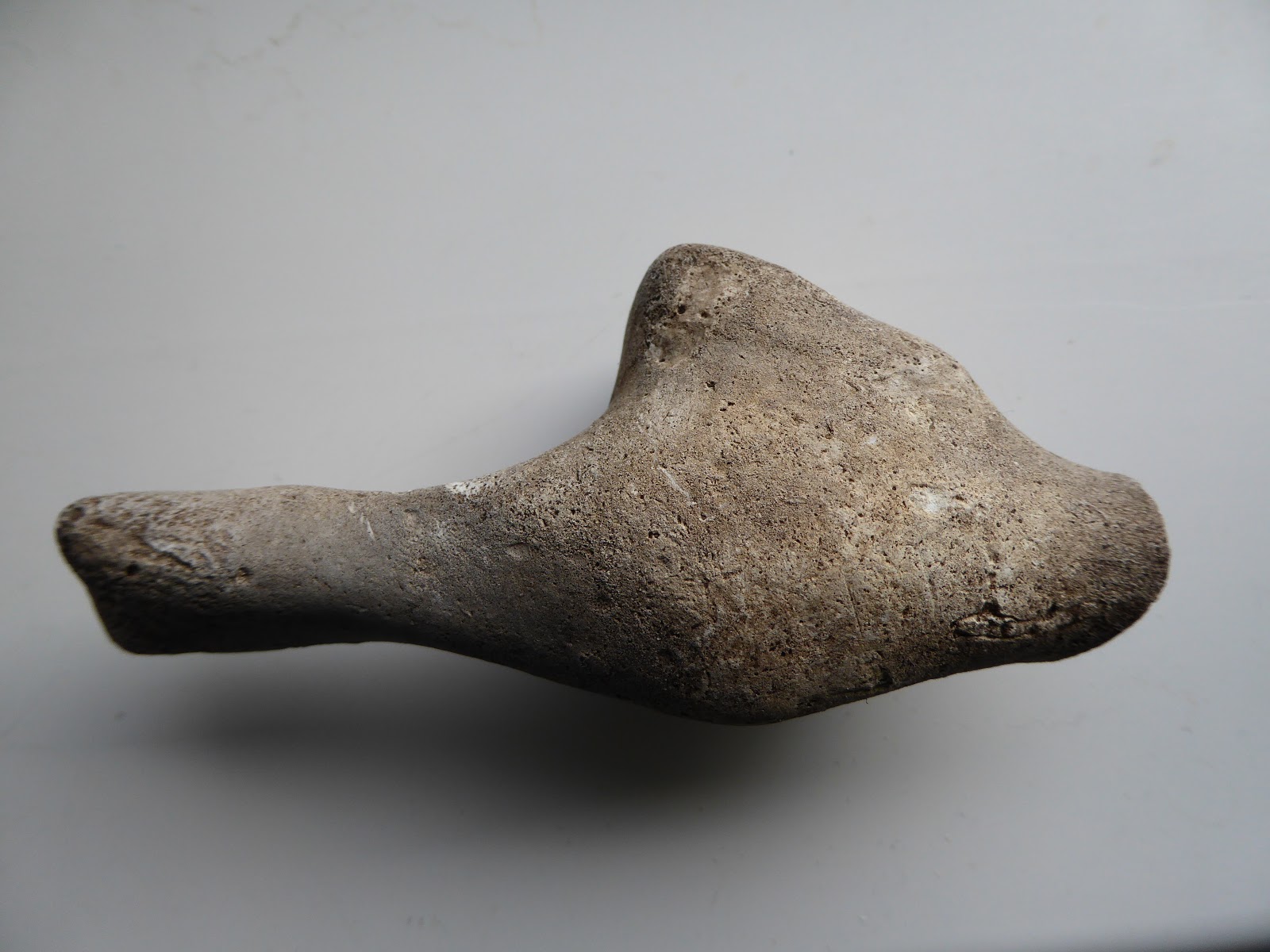
Below is an example of a flint nodule from my find site, which has minimal modification and could be used to convey many animal descriptions.

Suggested motifs: bear head, swan in flight, elephant head, bovine front, small finch like bird, ray/angel shark, gorilla strut, crocodile head, pointing hand, sauropod half leaning against a tree.

Although most of these suggested motifs are pure conjecture, (showing few details), all of these have been found repeatedly in materials from my site, some  in the same combinations, and all have highly detailed comparative examples, and this is clearly a prehistoric artifact.


 Above: ear, eye, and mouth features etched in cortex produce the bear head description facing right.


'Another problem is raised by the so-called 'figure stones', which are nodules with very little trimming or adaptation, but with fanciful resemblance to various animals, birds, reptiles, and even human beings. The flake which generally forms the 'eye' is often minute and in the right place, but the identification of the figure is largely a matter of conjecture, though some examples are almost convincing. Weather figure stones are due to man or to nature, it may be urged that the earliest sculptures known are in the round (as opposed to engraving or low relief), and it is not unreasonable to suppose that man's first attempts at art consisted in giving the finishing touches to a nodule in order to create or improve a likeness to some real or imaginary animal. One of the earliest instincts of children is to mould figures in clay, and this in itself might be used as an argument for the great antiquity of sculptures in the round'  Reginald  Smith, 1932.

Friday, 9 March 2018

Straight to the point- Lithic assembledge proves figuration topology.

Categorizing the assemblage from my site is a very daunting task, here are some initial results.

The pictures show worked finds from my site, points were selected and placed upright, then points with similar visual characteristics were placed alongside, to some degree.

Everything is worked, all bar one are flint, the vast majority of the stones qualify as blade tools.

Statistics can be produced on qualifying features of any recognized topology.

This is not the whole assemblage of points from my site, as more are added better topographical data will only add credence to some quite obvious findings.


What topology? if he says 'points'...I'll BL^%&Y K%&L HIM!  
  
I cannot as yet give you any accurate statistics, much more work needs to be done, but here are some common qualities to look out for at the tips of the points:

Double chevrons,  chevrons, inverse Y shapes, marks, chips, spots, sculpted bobble shapes. 

Proof of a topology of shapes incorporated into the tips of the points.

Suggested interpretation:- hooded and cloaked figure.